


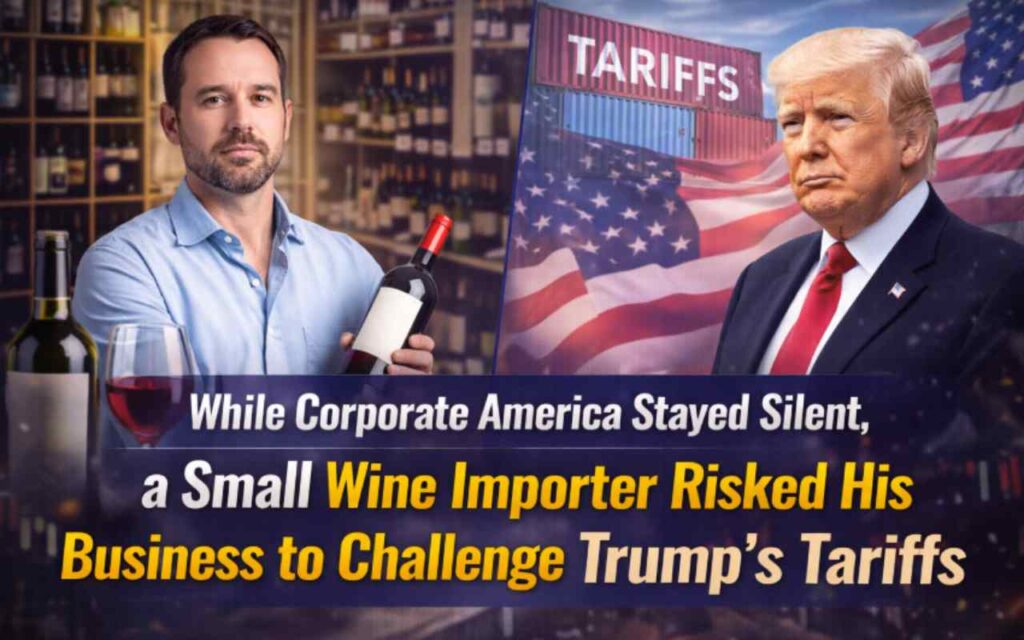
When the President of the United States announced plans to raise the nation’s effective tariff rate to levels not seen since the infamous Smoot-Hawley Tariff Act of 1930, the reaction from the corner offices of corporate America was deafeningly quiet. Multinational CEOs, acutely aware of how opposing the administration’s signature economic policy could invite devastating political and financial retaliation, largely chose to absorb the costs or quietly pass them on to consumers. With billions in annual revenue at stake, the leaders of the Fortune 500 stood entirely still.
But Victor Owen Schwartz, the owner of a small, family-run wine importing business based in New York, decided to take a giant step forward.
Schwartz, founder of VOS Selections, became the unlikely face of a historic legal battle to overturn the most sweeping executive tariffs in modern American history. Navigating a gauntlet of political backlash, immense legal pressure, and the threat of financial ruin, Schwartz’s fight culminated in a landmark decision by the United States Supreme Court. His victory not only saved his business but permanently altered the balance of power between the executive branch and Congress regarding global trade.
David Versus Goliath in the Global Trade War
To understand the magnitude of the legal earthquake that occurred, one must first understand the environment of fear that permeated the American business landscape. When the Trump administration unveiled its sweeping global trade policy, dubbed the “Liberation Day” tariffs, it sent shockwaves through the global supply chain. The policy slapped a baseline ten percent import tax on goods from nearly every trading partner on the globe, with reciprocal tariffs skyrocketing to fifty percent for certain European goods and an astonishing one hundred and forty-five percent on specific imports from China.
For massive conglomerates, a ten percent margin squeeze is a headache that can be mitigated through creative accounting, supply chain relocation, or price hikes. For a small business built on razor-thin margins and decades-old international relationships, it is an extinction-level event.
Schwartz felt he had no choice. Corporate giants were actively avoiding the crosshairs of the White House. The administration had a documented history of threatening individual companies while simultaneously granting lucrative tariff exemptions to political allies. Facing an ecosystem collapse, Schwartz partnered with the Liberty Justice Center, a libertarian-leaning nonprofit public-interest law firm, to file a lawsuit directly challenging the President’s authority. He became the lead plaintiff in VOS Selections, Inc. v. Trump, standing as the last line of defense for free enterprise when the titans of industry refused to enter the arena.
The Origins of a Vintage Enterprise
Victor Schwartz never intended to become a constitutional crusader. His journey began with a simple, profound passion for food, culture, and travel. A graduate of Cornell University’s class of 1980, Schwartz caught the wine bug after taking a legendary introductory course on vintages and terroir during his senior year. That academic curiosity led him from catering gigs in New York City to picking grapes in the sun-drenched vineyards of France during the 1980s.
In 1987, he channeled this passion into a business, founding VOS Selections. Over nearly four decades, Schwartz meticulously scoured the globe for the most authentic, terroir-driven wines, spirits, and sake. Today, the company imports products from sixteen countries across five continents, operating as a vital bridge between small, multi-generational family farms in Europe and fine dining establishments across the United States. Schwartz now runs the enterprise alongside his daughter, Chloë Syrah Schwartz, representing a distinctly American dream built on international cooperation.
“I didn’t start my company with the idea of, like, I’m going to sue the president of the United States someday,” Schwartz noted in an interview following his legal victory. “That was not my goal in life. I just wanted to bring in really nice wine to sell to people that enjoyed them.”
The Architecture of the Liberation Day Tariffs
The legal conflict centered not on whether tariffs are good or bad economic policy, but on whether the President actually had the legal authority to impose them unilaterally.
The United States Constitution explicitly grants the power to lay and collect taxes, duties, and tariffs to Congress, not the executive branch. To bypass the legislative gridlock of Capitol Hill, the administration invoked a relatively obscure 1977 law known as the International Emergency Economic Powers Act (IEEPA).
Historically, IEEPA was designed to give the president broad powers to regulate financial transactions during a declared national emergency. It has traditionally been used to freeze the assets of foreign terrorists, sanction hostile regimes like Iran or North Korea, or block the property of international narcotics traffickers. No president in American history had ever attempted to use IEEPA to enact sweeping, global taxes on allied nations.
The administration argued that persistent trade deficits with allied nations and the influx of illegal drugs constituted an “unusual and extraordinary threat” to the United States, thereby triggering the emergency powers. For importers like VOS Selections, the justification was not only nonsensical but immediately catastrophic. The stroke of a pen instantly upended decades of financial planning.
Summary of Tariff Impacts on Small Businesses
The Silence of the Corporate Titans
Perhaps the most striking element of the legal battle was who was missing from the courtroom. The roster of plaintiffs read like a directory of Main Street America: a wine importer, a fishing tackle retailer, an educational toy maker, and a plumbing manufacturer.
Where were the massive tech companies that rely on foreign microchips? Where were the massive retail chains that import billions of dollars of consumer goods?
The silence was a calculated maneuver. Legal analysts and trade experts pointed out that fighting the administration in federal court invited immediate executive retaliation. The administration possessed the power to grant arbitrary exclusions to the tariffs. For a multi-billion-dollar corporation, it was far more cost-effective to dispatch an army of lobbyists to Washington to quietly beg for a targeted exemption than it was to publicly challenge the legality of the entire program.
This dynamic left small businesses holding the bag. Without the resources to hire high-priced lobbyists, companies like VOS Selections were forced to absorb the costs. “The math was simple,” explained Rick Woldenberg, CEO of Learning Resources, another business that eventually joined the consolidated legal fight. “I could not afford the tax that they wanted to hit me with.”
Schwartz realized that if a small business didn’t step up to challenge the executive overreach, the new tariffs would become a permanent, unchallenged fixture of the American economy. “It takes a little match to start the fire,” Schwartz reflected. “I’m not going to feel badly about that. I’m going to feel proud about that.”
Also, Check Lindsey Vonn’s 2026 Olympics Journey, Despite Her Crash, Is Anything But a Failure
Building the Legal Coalition
The genesis of the lawsuit came through a serendipitous family connection. As Schwartz scrambled to understand how his company could survive the sudden tax burden, a relative pointed him toward Ilya Somin, a constitutional law professor at George Mason University and chair of constitutional studies at the Cato Institute.
Somin had publicly issued a call for potential plaintiffs who possessed the legal standing to challenge the unprecedented use of IEEPA in court. Schwartz reached out to explain the dire situation facing the wine industry. Recognizing the perfect test case, the legal team at the Liberty Justice Center stepped in. After speaking with dozens of terrified small business owners, the firm asked Schwartz to serve as the lead plaintiff.
Though he experienced significant trepidation about putting a target on his family’s business, Schwartz agreed. On April 14, 2025, VOS Selections, Inc. v. Trump was officially filed in the United States Court of International Trade. The complaint argued a fundamental constitutional principle: the President does not possess unbounded authority to levy taxes on every corner of the world without congressional approval.
The Wine Industry Caught in the Crossfire
The specific choice of a wine importer as the lead plaintiff highlighted the profound absurdity of applying national security emergency powers to global commerce. Wine is an agricultural product intrinsically tied to geography, climate, and generational farming. It is not fungible. An American distributor cannot simply replace a French Chablis or an Italian Barolo with a domestic alternative; the product is defined by its origin.
The European wine trade faced total devastation under the new tariff regime. Lamberto Frescobaldi, president of the Unione Italiana Vini, publicly pleaded for wine to be exempt from the escalating hostility. The European export market to the United States is worth nearly five billion euros annually, with Italy alone accounting for two billion. In stark contrast, American wine exports to the European Union total just over three hundred million euros.
The imbalance meant that retaliatory tariffs from the European Union would cripple American exporters, while the US tariffs strangled domestic importers. For Schwartz, the tariffs meant finding six-figure sums in cash just to clear his shipments through customs. The company was forced to revise its pricing catalog hundreds of times in a matter of months, passing along the uncertainty to local restaurants, boutique wine shops, and American consumers. The ecosystem built on loyalty and trust was being taxed out of existence.
A Rollercoaster in the Federal Courts
The legal journey of VOS Selections was fraught with dramatic judicial whiplash. In late May of 2025, Schwartz received an email while cooking dinner at his Manhattan apartment. A three-judge panel on the US Court of International Trade had ruled unanimously in his favor. The court struck down the tariffs, declaring that the administration had grossly overstepped the scope of the 1977 International Emergency Economic Powers Act.
Schwartz celebrated the momentary victory with his wife by opening a special bottle of French Vermentino. However, the celebration was short-lived.
Just two days later, a federal appeals court granted an emergency motion filed by the Department of Justice, placing a stay on the lower court’s ruling. The tariffs were temporarily reinstated while the administration prepared an aggressive appeal. Over the ensuing months, the case was consolidated with parallel lawsuits filed by a coalition of twelve state attorneys general and other aggrieved small businesses. The consolidated legal battle bypassed the usual slow grind of the appellate system, rocketing straight toward the highest court in the land.
The Supreme Court Showdown
The climax of Schwartz’s unintentional crusade arrived on Friday, February 20, 2026. Inside a packed courtroom attended by high-ranking cabinet officials, including the Treasury Secretary and the US Trade Representative, the United States Supreme Court delivered a decisive, landmark ruling.
In a 6-3 decision authored by Chief Justice John Roberts, the Court struck down the administration’s sweeping global tariffs, declaring them unconstitutional and illegal. The ruling dealt a fatal blow to the executive branch’s attempt to bypass Congress on matters of international taxation.
Chief Justice Roberts systematically dismantled the government’s legal defense. The administration had heavily relied on a single provision within IEEPA stating that the executive branch could “regulate” imports during an emergency. The Court rejected this broad interpretation outright.
“Based on two words separated by 16 others—’regulate’ and ‘importation’—the President asserts the independent power to impose tariffs on imports from any country, of any product, at any rate, for any amount of time,” Chief Justice Roberts wrote in the majority opinion. “Those words cannot bear such weight.”
The Court reaffirmed that under the Constitution, the power to tax belongs almost exclusively to the legislative branch. The ruling clarified that a trade deficit does not constitute a national security emergency, stripping the executive branch of its favorite weapon in the global trade war.
For Victor Schwartz, who listened to the decision with bated breath, the moment was euphoric. “It was out of body,” he described in an interview shortly after the ruling was publicized. “It was just incredible.”
The Multi-Billion Dollar Aftermath
The immediate fallout from the Supreme Court decision was monumental. Beyond halting the ongoing economic strangulation of small importers, the ruling triggered a massive financial reckoning.
Because the tariffs were collected illegally under an unconstitutional application of executive power, the federal government suddenly found itself on the hook for unprecedented refunds. According to US Customs and Border Protection tariff revenue data, the victory for Schwartz and his fellow plaintiffs meant that American importers were potentially due refunds totaling at least one hundred and thirty-four billion dollars.
The Ripple Effects of the Supreme Court Ruling
-
Immediate Relief for Importers: Small businesses were instantly freed from the crippling cash-flow constraints required to pay the baseline and reciprocal tariffs at the ports of entry.
-
Massive Federal Refunds: The Department of the Treasury faced the logistical nightmare of returning over $130 billion in illegally collected import taxes to the domestic businesses that paid them.
-
Restoration of Congressional Power: The ruling definitively blocked future presidents from using IEEPA as a backdoor mechanism to wage unilateral trade wars, forcing any future tariff legislation to go through the House of Representatives and the Senate.
-
Global Market Stabilization: International markets rallied on the news, as the threat of a constantly escalating, tit-for-tat global trade war was neutralized by the American judicial system.
The administration, predictably, reacted with fierce condemnation. At a press conference following the ruling, the President slammed the Supreme Court’s decision as “deeply disappointing” and vowed to find alternative legislative avenues to replace the rejected policies. The rhetoric signaled that while the battle over IEEPA had been won, the broader war over American protectionism and free trade would simply shift to the halls of Congress.
A Toast to the Separation of Powers
Victor Schwartz paid a steep personal price for his willingness to stand in the spotlight. Following the initial filing of the lawsuit, he became the target of relentless digital harassment. “I am under constant attack through text, email, and I can’t stop it,” he admitted during the height of the litigation. “It’s a little ugly. We keep our doors locked at the office.”
Despite the vitriol and the terrifying prospect of taking on the full weight of the federal government, Schwartz remained anchored by his principles. He recognized that a system of free enterprise cannot function if the rules of the game can be altered overnight by executive fiat.
By risking the ecosystem he spent thirty-eight years building, the New York wine importer achieved what the combined lobbying power of corporate America could not—or would not—do. He held the executive branch accountable to the United States Constitution.
As the dust settled on the historic Supreme Court victory, Schwartz was asked how he planned to celebrate the preservation of his livelihood and the monumental legal precedent he had helped establish. True to his roots as an uncompromising purveyor of the world’s finest viticulture, his answer was simple. He would be opening a bottle of wine.
“I think the best thing to drink is something from France,” Schwartz said with a profound sense of relief. “Something with some age.”
Conclusion
The landmark victory in VOS Selections, Inc. v. Trump—consolidated at the Supreme Court with parallel challenges—serves as a defining moment in modern American economic and constitutional history. While the titans of corporate America calculated the political risks and chose silence, it took the courage of a small, family-run wine importer to step into the crosshairs of the executive branch. Victor Owen Schwartz did not set out to be a constitutional crusader; his primary objective was simply to protect a business built on nearly forty years of global relationships, trust, and a passion for terroir-driven wine.
Yet, by refusing to capitulate to the “Liberation Day” tariffs, Schwartz ignited a legal firestorm that fundamentally reaffirmed the separation of powers. The 6-3 Supreme Court decision authored by Chief Justice John Roberts sent an unequivocal message: the United States Constitution vests the power of taxation and trade regulation squarely in the hands of Congress, and no president can unilaterally bypass that legislative authority by citing vague national emergencies.
Ultimately, this David-versus-Goliath narrative is a testament to the enduring power of the American judicial system. It proves that even in an era dominated by multinational conglomerates and sweeping executive action, a single small business owner still possesses the ability to hold the highest office in the land accountable to the rule of law.
Frequently Asked Questions
What was the core legal argument against the “Liberation Day” tariffs?
The lawsuit argued that the executive branch violated the United States Constitution by unilaterally imposing global taxes. The Constitution grants Congress the exclusive authority to levy tariffs and duties. The plaintiffs maintained that the administration’s justification for the tariffs—a general trade deficit—did not constitute a legitimate national security emergency, making the action an illegal overreach of executive power.
What is the International Emergency Economic Powers Act (IEEPA)?
Enacted in 1977, IEEPA is a federal law designed to give the president authority to regulate commerce, freeze assets, or block financial transactions in response to an “unusual and extraordinary threat” originating outside the United States. Historically, presidents have used IEEPA to sanction hostile regimes, drug cartels, or terrorist organizations. The Trump administration controversially attempted to use it to impose blanket, worldwide tariffs on allied and adversarial nations alike.
Why did the Supreme Court strike down the tariffs?
In a 6-3 decision, the Supreme Court ruled that IEEPA does not authorize the president to impose tariffs. Chief Justice John Roberts wrote that the word “regulate” within the 1977 statute could not be stretched to include the sweeping power to tax global imports. The Court emphasized that when Congress delegates the power to impose tariffs, it does so with strict, specific constraints, which were entirely absent in the administration’s actions.
Why didn’t massive multinational corporations lead the lawsuit?
Many large corporations chose to stay on the sidelines due to fears of political and financial retaliation from the White House. For multibillion-dollar conglomerates, it was often safer and more cost-effective to deploy lobbyists to quietly negotiate targeted tariff exemptions (exclusions) rather than publicly challenge the legality of the president’s signature economic policy.
How did the tariffs specifically threaten the wine importing industry?
Unlike manufactured goods like microchips or plastics, wine is an agricultural product deeply tied to its geographic origin (terroir) and cannot be substituted. An importer cannot simply replace a French Champagne or an Italian Barolo with a domestic product. The massive 10% to 50% reciprocal tariffs threatened to sever decades-old relationships with European family farms and created impossible cash-flow bottlenecks for small importers who had to pay the taxes upfront at customs.
Will businesses receive refunds for the tariffs they already paid?
Yes, the Supreme Court’s ruling paves the way for the federal government to refund the illegally collected duties, which are estimated to total over $130 billion. However, the exact administrative mechanism for returning these funds to the affected importers remains highly complex. Dissenting justices noted that the refund process is likely to be a massive logistical challenge, especially for businesses that may have already passed some of the costs down the supply chain.