


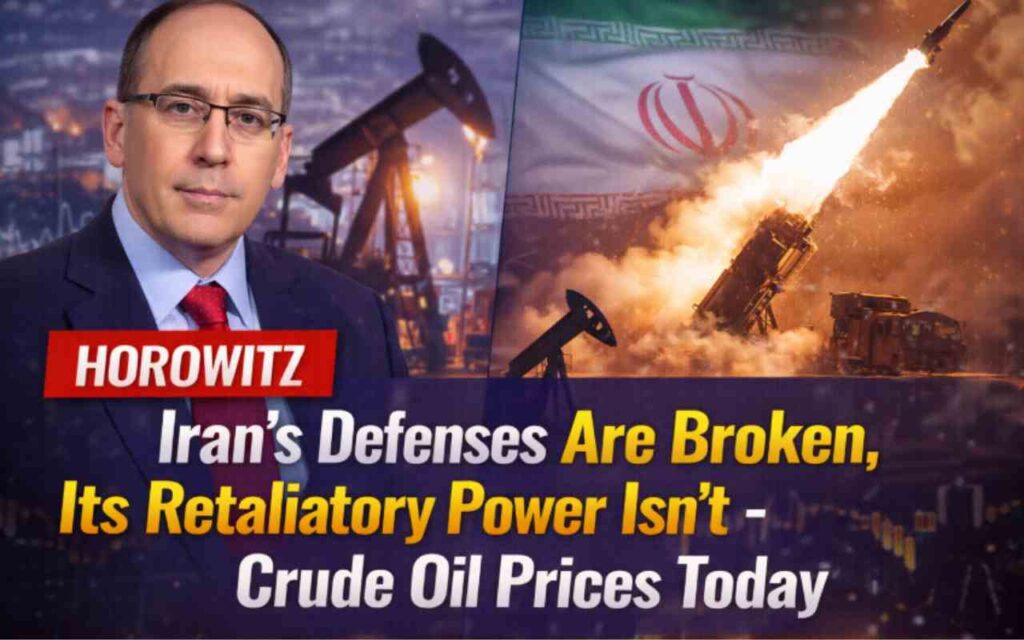
DUBAI — A startling new assessment of Iran’s military capabilities has sent ripples through defense circles and global energy markets this week. Michael Horowitz, a leading geopolitical analyst and head of intelligence at Le Beck International, has issued a sobering analysis of the Islamic Republic’s current military posture: while Israel’s precision strikes have effectively stripped Iran of its air defense shield, Tehran retains a “formidable” offensive capacity capable of crippling the global oil supply. Horowitz Iran’s Defenses Are Broken, Its Retaliatory Power Isn’t – Crude Oil Prices Today
This paradoxical reality—a nation that is “practically naked” defensively yet offensively potent—has created a volatile new equilibrium in the Middle East. As tensions mount between Washington, Tel Aviv, and Tehran, crude oil prices are reacting to the renewed threat of a closure of the Strait of Hormuz, the world’s most critical energy chokepoint.
The “Naked” Defender: A Sky Left Unguarded
In a comprehensive security briefing released Wednesday, Horowitz detailed the catastrophic degradation of Iran’s integrated air defense network (IADS). Following a series of targeted Israeli campaigns over the last twelve months—most notably the dismantling of Russian-made S-300 batteries protecting vital nuclear and industrial sites—Iran’s airspace has been rendered virtually porous.
“In terms of purely defensive capabilities, Iran is practically naked,” Horowitz stated. The analysis highlights that the regime has lost its primary means of intercepting advanced Western aircraft, leaving its nuclear infrastructure and command centers exposed to potential follow-up strikes by the United States or Israel.
The psychological and tactical impact of this exposure cannot be overstated. For decades, Tehran relied on a strategy of deterrence by denial, aiming to make any aerial campaign too costly for the attacker. That equation has now collapsed.
The “Porcupine” Strategy: Retaliatory Power Intact
However, military planners warn against interpreting this defensive weakness as total helplessness. Horowitz’s report emphasizes that Iran has successfully pivoted to a strategy of asymmetric saturation. While it can no longer stop incoming fire, it retains the capacity to unleash a devastating volume of outgoing fire.
“The regime still has a large arsenal of short and medium-range missiles that can easily hit US bases in the Middle East,” Horowitz warned. The assessment points to thousands of ballistic missiles, cruise missiles, and loitering munitions (suicide drones) hidden in deep-buried silos and mobile launchers across the Zagros Mountains.
Key Offensive Assets Remaining:
-
Sejjil & Kheibar Missiles: Medium-range ballistic missiles capable of reaching Tel Aviv and US bases in Qatar.
-
One-Way Attack Drones: Shahed-136 variants, which have proven effective in swarming attacks to overwhelm localized defenses (like the Iron Dome or Patriot batteries).
-
Naval Mines & Fast Boats: Assets specifically designed for littoral warfare in the Persian Gulf.
Oil Markets React: The Strait of Hormuz Factor
The most immediate global impact of Horowitz’s assessment is visible in the energy sector. Brent crude futures ticked upward in early trading today, hovering near $76.80 per barrel, as traders digested the implications of an Iran that feels cornered.
Market analysts fear that if the Iranian leadership feels an existential threat due to its lack of air defenses, it may resort to its “nuclear option” of economic warfare: shutting down the Strait of Hormuz.
“The Islamic Republic has long prepared a set of military assets meant to shut down this key maritime route,” Horowitz noted. “This would create an economic shock that Iran could exploit.”
Approximately 20% of the world’s total oil consumption passes through this narrow waterway. Any disruption here would not only spike oil prices past $100/barrel but also sever supply chains for liquefied natural gas (LNG) heading to Europe and Asia.
Table: Potential Market Impact of Hormuz Disruption
The Strategic Dilemma for Washington
The Horowitz report complicates the decision-making process for the White House. The upcoming deployment of additional US carrier strike groups to the region signals a readiness to capitalize on Iran’s defensive gaps. Yet, the cost of “finishing the job” remains prohibitively high.
“Airpower can punish and paralyze, but it would need a simultaneous political fracture on the ground… to really deliver a full collapse,” Horowitz argued, dismissing the notion that airstrikes alone could trigger regime change.
Instead, a US or Israeli strike runs the risk of triggering the very retaliation they seek to deter. Without a defensive shield, Tehran’s only survival mechanism is offense. This “use it or lose it” mentality regarding their missile arsenal significantly lowers the threshold for a regional war.
Conclusion: A Fragile Standoff
As of January 2026, the Middle East stands in a precarious deadlock. Iran is physically vulnerable but strategically dangerous. Its defenses are broken, shattered by superior technology, yet its sword remains sharp.
For global markets, the message is clear: the risk premium on oil is not going away. The next phase of this conflict will not be defined by whether Iran can defend its skies, but by how severely it is willing to burn the ground—and the global economy—in response.