


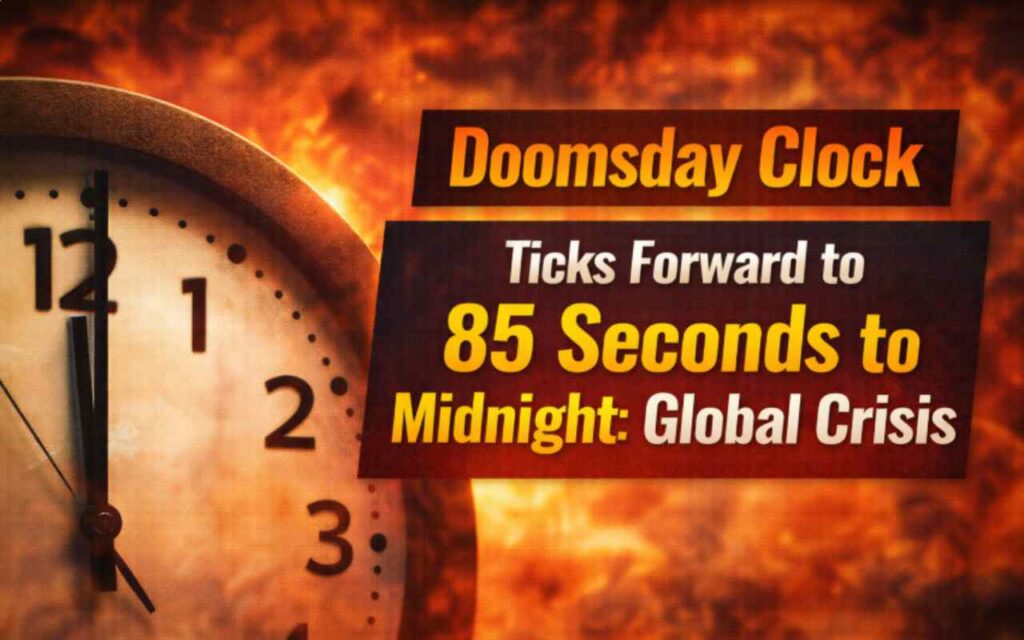
Washington, D.C. — In a chilling declaration that reverberated through the halls of global power and scientific communities alike, the Bulletin of the Atomic Scientists has officially moved the hands of the Doomsday Clock forward. The symbolic timepiece now stands at 85 seconds to midnight—the closest humanity has ever been to global catastrophe in the clock’s 79-year history. Doomsday Clock Ticks Forward to 85 Seconds to Midnight: Global Crisis
This adjustment, announced on Tuesday, January 27, 2026, shaves four critical seconds off the previous record of 89 seconds set in 2025. It serves as a stark indictment of world leaders who, according to the Bulletin, have failed to arrest the cascading threats of nuclear proliferation, climate collapse, and the unchecked rise of artificial intelligence.
The Verdict: A World on the Brink
The announcement was made by the Bulletin’s Science and Security Board (SASB), a select group of globally recognized leaders in nuclear physics, climate science, and military strategy. Their message was unambiguous: the guardrails that once protected civilization from self-destruction are being dismantled in real-time.
For the first time in decades, the world faces the tangible prospect of a nuclear arms race without legal constraints, a climate system tipping into irreversibility, and an information ecosystem so polluted by artificial intelligence that the very concept of “truth” is under siege.
“We are living in a time of unprecedented danger, and the Doomsday Clock time reflects that reality,” stated Alexandra Bell, President and CEO of the Bulletin. “85 seconds is not just a metaphor; it is a scream into the void. We are running out of time.”
By the Numbers: The March Toward Midnight
To understand the gravity of the current setting, it is essential to view the clock’s movement over the last decade. The trajectory has been relentlessly negative, moving from minutes to mere seconds as the post-Cold War stability fractures.
The Nuclear Precipice: A World Without Guardrails
The primary catalyst for this year’s movement is the disintegration of the global nuclear arms control architecture. The Bulletin cited the looming expiration of the New START Treaty between the United States and Russia, set to lapse on February 4, 2026. With no successor agreement in place and diplomatic channels largely frozen, the world is staring down the barrel of a new era: one where nuclear arsenals are unconstrained by treaty limits for the first time in over 50 years.
Daniel Holz, chair of the SASB, emphasized that this is not a theoretical danger. The unchecked modernization of nuclear triads in the United States, Russia, and China is creating a three-way arms race that is inherently unstable. Unlike the binary logic of the Cold War, this multipolar nuclear dynamic creates complex scenarios where miscalculation is far more likely.
Furthermore, the Bulletin highlighted “loose nuclear rhetoric” that has normalized the idea of tactical nuclear strikes. The ongoing conflicts in Eastern Europe and the Middle East have seen nuclear-armed states engaging in direct or proxy warfare, with threats of escalation becoming a routine part of diplomatic signaling. The modernization of delivery systems—including hypersonic missiles—has reduced decision-making time for leaders from minutes to seconds, increasing the risk of accidental launch.
The Climate Emergency: Past the Point of Promises
While nuclear war represents the threat of sudden annihilation, climate change remains the threat of slow-motion collapse. The Bulletin’s assessment for 2026 was scathing regarding global environmental efforts. Despite years of pledges at COP summits, 2025 was recorded as the hottest year in human history, shattering temperature records across every continent.
The scientific consensus is that the 1.5-degree Celsius target—the threshold to avoid the worst impacts of climate breakdown—is rapidly slipping out of reach, if not already lost. The Bulletin noted that the “green transition” is happening, but far too slowly to counteract the entrenched power of the fossil fuel economy.
A specific alarm was raised regarding the destabilization of polar ice sheets and the disruption of ocean currents. These “tipping points” are no longer distant future scenarios but active geological processes. The Board argued that the geopolitical competition fueled by the Ukraine war and tensions in the Pacific has distracted major powers from the cooperative effort required to slash emissions. Instead of collaboration, nations are securing fossil fuel supply lines for energy security, prioritizing short-term military readiness over long-term planetary survival.
Information Armageddon: The AI Threat
A distinct and rapidly growing factor in the 2026 setting is the corrosive effect of unchecked Artificial Intelligence. The Bulletin described this phenomenon as an “information armageddon.”
Nobel Peace Prize laureate Maria Ressa, who joined the Bulletin for the announcement, articulated the danger clearly. The widespread availability of generative AI tools has supercharged the spread of disinformation. State actors and rogue entities now possess the capability to flood the global information ecosystem with high-quality deepfakes and synthetic propaganda at virtually zero cost.
This erosion of truth has direct security implications. How can a democracy function if its citizens cannot agree on basic facts? How can leaders negotiate nuclear treaties if they cannot verify the authenticity of their counterparts’ communications?
The integration of AI into military command-and-control systems was also cited as a critical risk. The rush to automate weapons systems—taking the “human out of the loop”—raises the terrifying prospect of machines making kill decisions or escalating conflicts faster than human diplomacy can intervene. The Bulletin warned that we are placing the fate of the world in the hands of algorithms that we do not fully understand and cannot fully control.
Biological Shadows
Lurking behind the headlines of bombs and bots is the biological threat. The rapid advancement of biotechnology, specifically in the realm of synthetic biology, has democratized the ability to manipulate pathogens. The Bulletin warned that the barrier to entry for creating weaponized viruses is lowering. Without robust international oversight—which is currently lacking—the potential for an accidental lab leak or a deliberate biological attack remains a catastrophic variable in the Doomsday equation.
A Crisis of Leadership
Ultimately, the Doomsday Clock is not a measure of threats alone, but a measure of humanity’s response to those threats. The move to 85 seconds is a vote of no confidence in the current global leadership. The Bulletin’s statement painted a picture of a fractured international order, where the institutions built to maintain peace—the United Nations, the Security Council, and various treaty organizations—are paralyzed by vetoes and infighting.
The rise of nationalistic autocracies was highlighted as a force multiplier for all other risks. Leaders who prioritize performative strength over cooperative diplomacy are dismantling the trust networks necessary to solve transnational problems. When nations turn inward, the global commons—whether the atmosphere or the nuclear non-proliferation regime—are left unguarded.
Turning Back the Clock
Despite the grim assessment, the Bulletin of the Atomic Scientists insists that the future is not written. The Clock is a warning, not a prophecy. The movement toward midnight is reversible, but only with radical and immediate action.
The scientists outlined a series of urgent steps required to move the hands back:
-
Nuclear Re-engagement: The US and Russia must immediately return to the negotiating table to extend New START or draft a successor treaty, decoupling arms control from their other geopolitical disputes.
-
Climate Cooperation: Wealthy nations must fulfill their financial commitments to the Global South to facilitate a rapid transition away from hydrocarbons.
-
AI Regulation: International norms and hard laws must be established to govern the use of AI in military systems and to label synthetic content clearly.
-
Bio-surveillance: A massive investment in global biological monitoring systems is needed to detect and contain new pathogens before they become pandemics.
Conclusion
As the world processes the news of the Clock ticking to 85 seconds, the message is clear: the margin for error has evaporated. We are operating in the danger zone. The comfortable buffer of the post-Cold War era, when the clock stood at 17 minutes to midnight, feels like a distant memory.
The seconds ticking away are not just units of time; they represent the vanishing opportunities to choose survival over suicide. The scientists have issued their warning. The question now remains whether the world—and its leaders—will listen before the clock strikes twelve.