


The Boiling Point: Yemen Missile Attack Signals Dangerous New Phase in US-Israel-Iran War
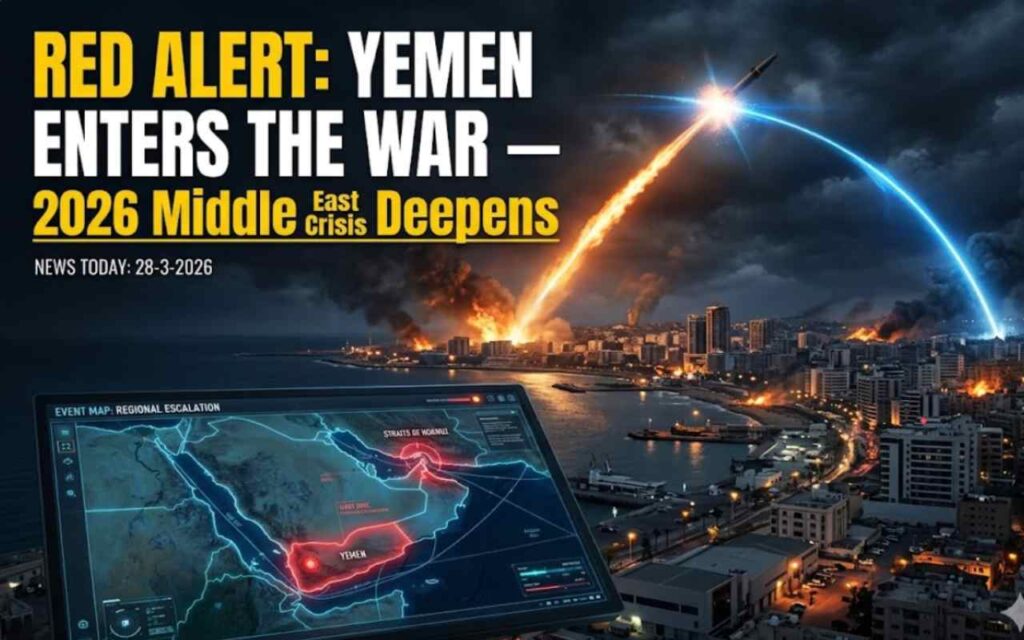
The morning of March 28, 2026, began with a chilling reminder that the world is standing on the precipice of a global catastrophe. For the first time since the joint U.S.-Israeli campaign against Iran—codenamed Operation Epic Fury—commenced exactly one month ago, a long-range ballistic missile was launched from Yemen toward Israeli territory. This unprecedented missile fired from Yemen as Israel and US target Iran marks a definitive shift in the conflict’s geography, transforming a localized military operation into a multi-front regional conflagration that threatens the very stability of the global economy.
As sirens wailed across Be’er Sheva and the Negev desert, the Israeli Defense Forces (IDF) confirmed that their sophisticated aerial defense systems successfully intercepted the threat. However, the psychological and strategic impact remains. The Iran-aligned Houthi rebels, who had previously maintained a tense neutrality throughout the first four weeks of the war, have now “put their fingers on the trigger.” This development comes just hours after the Trump administration expanded its military objectives in Tehran, targeting heavy water complexes and yellowcake production plants in a desperate bid to dismantle the regime’s nuclear backbone once and for all.
For the average American, this isn’t just a headline about a distant desert war. It is an event with immediate domestic consequences. From the gas pump to the grocery aisle, the ripples of this missile fired from Yemen as Israel and US target Iran are being felt in real-time. With the Strait of Hormuz effectively a “no-go zone” and oil prices skyrocketing to levels not seen in decades, the financial security of millions of U.S. households is now intrinsically tied to the flight paths of missiles over the Red Sea.
Breaking Down the March 28 Escalation: Operation Epic Fury Hits Day 29
The timeline of the last 24 hours reads like a screenplay for a geopolitical thriller, yet the casualties are tragically real. Since the conflict erupted on February 28, 2026, the death toll in Iran has surpassed 1,900, while Lebanon mourns over 1,100 lives lost. Today’s events, however, suggest that the most violent chapters may still be ahead of us.
The Yemen Launch: A New Front Opens
The IDF’s detection of a missile from Yemen early Saturday morning is the “black swan” event military analysts have feared. For years, the Houthis have refined their drone and missile capabilities with Iranian assistance. Their entry into the war theatre means that Israel must now divide its air defense resources—the Iron Dome, David’s Sling, and Arrow systems—across three distinct vectors: the northern border with Hezbollah, the direct eastern threat from Iran, and the southern corridor from Yemen.
US and Israel Strike Iranian Nuclear Assets
Simultaneous with the Yemeni launch, U.S. and Israeli air assets conducted high-precision strikes on the Shahid Khondab Heavy Water Complex in Arak and the Ardakan yellowcake plant in Yazd. While Iranian officials claim the strikes caused no environmental contamination, the symbolic message is clear: Washington is no longer interested in containment; the goal is total neutralization.
Debris and Fire in the UAE
The fallout of this war is not confined to the primary combatants. In Abu Dhabi, five people were injured when debris from intercepted Iranian missiles fell near the Khalifa Economic Zones (KEZAD). This highlights the precarious position of regional allies who host American military bases, making them secondary targets for the “Axis of Resistance.”
Also, Read Medicare Benefits Change in 2026: What Seniors Need to Know
Global Economic Impact: The High Cost of War
The missile fired from Yemen as Israel and US target Iran on March 28 has sent shockwaves through the financial markets. Investors, already skittish after five straight weeks of losses on Wall Street, are now pricing in a “prolonged blockade” scenario. The closure of the Strait of Hormuz has essentially stranded 20% of the world’s oil supply, leading to what the International Energy Agency (IEA) calls the “greatest global energy security challenge in history.”
Crude Oil and LNG Price Volatility
Strategic Analysis: The Trump Administration’s Five Objectives
In a month-long campaign that has already cost the U.S. military an estimated $18 billion, President Donald Trump has outlined a shifting set of goals for Operation Epic Fury. What began as a preemptive strike has evolved into a comprehensive regional restructuring.
-
Degrading Missile Capabilities: The Pentagon claims that approximately one-third of Iran’s ballistic missile arsenal has been destroyed, with over 190 launchers neutralized.
-
Neutralizing Nuclear Progress: The strikes on Arak and Yazd today are part of a broader mandate to ensure Tehran “never has a nuclear weapon.”
-
Leadership Removal: The assassination of Supreme Leader Ali Khamenei in the first week of the war created a power vacuum that the U.S. is looking to fill with more “cooperative” elements.
-
Securing Global Trade: Reopening the Strait of Hormuz remains the highest economic priority, though military experts warn that a maritime blockade is much easier to start than to end.
-
Protecting Regional Allies: By striking Houthi and Hezbollah assets, the U.S. aims to shield Saudi Arabia, the UAE, and Israel from retaliatory “sleeper cell” attacks.
The missile fired from Yemen as Israel and US target Iran today proves that despite the heavy bombardment, the “Axis of Resistance” retains significant “second-strike” capabilities.
The Humanitarian Crisis and Regional Spillover
Beyond the military and economic metrics, a human tragedy is unfolding. The “grocery supply emergency” in the Gulf states is a direct consequence of the disrupted shipping lanes. Countries like Qatar and Kuwait, which rely on the Strait of Hormuz for 80% of their caloric intake, are seeing food prices rise by as much as 120%.
In Iran, the civilian population is caught between a crumbling regime and a foreign military campaign. Reports of a U.S. strike on a school near Bandar Abbas, which allegedly killed 170 people, have sparked international condemnation and a UN demand for “justice.” The U.S. military maintains that the school was adjacent to an IRGC naval base and that the incident is under investigation.
For U.S. service members stationed in the region, the risk has never been higher. At least 15 American soldiers have been killed since February 28, and several others were wounded just yesterday at the Prince Sultan Air Base in Saudi Arabia. This highlights a critical fact: U.S. personnel are not just observers; they are direct targets in this escalating drama.
Expert Insights: Why Yemen Matters Now
To understand why the missile fired from Yemen as Israel and US target Iran is such a pivotal moment, we must look at the geography of the Red Sea. The Houthis control the Bab al-Mandeb Strait, a narrow chokepoint that serves as the gateway to the Suez Canal. If the rebels decide to transition from “trigger readiness” to a full-scale maritime blockade, they could effectively shut down 12% of global trade.
“The Houthi launch is a signal to Washington,” says one senior fellow at a D.C.-based think tank. “They are proving they can bypass the regional blockade and strike the Israeli heartland. This forces the U.S. to choose: do we escalate against Yemen and risk a total Red Sea shutdown, or do we pull back on the Iran strikes to prevent a wider war?”
As of March 28, the Trump administration appears to be choosing escalation. Secretary of State Marco Rubio, currently attending a G7 summit in France, remarked that while the war might end in “weeks, not months,” the U.S. is prepared to deploy up to 10,000 additional ground troops as a “contingency.”
How to Prepare: Navigating the 2026 Economic Volatility
The missile fired from Yemen as Israel and the US target Iran on March 28 is a clear sign that the “new normal” is one of high volatility. For Americans concerned about their financial future, now is the time to review investment portfolios and household budgets.
Essential Financial Steps for a War Economy:
-
Energy Hedging: Expect gasoline and heating oil prices to remain elevated through the summer of 2026. If you have the option to lock in utility rates, now may be the final window.
-
Inflation-Protected Securities: With CPI forecasts being revised upward to 3.5% or higher, Treasury Inflation-Protected Securities (TIPS) are becoming a popular hedge for retirees.
-
Job Market Awareness: Sectors like defense, cybersecurity, and domestic energy production are seeing a hiring surge. Conversely, international travel and luxury retail are facing significant headwinds.
-
Supply Chain Resilience: The “grocery emergency” in the Middle East could lead to localized shortages of specific imported goods in the U.S. as global shipping is rerouted around the Cape of Good Hope.
Conclusion: A World Awaiting the Next Move
The missile fired from Yemen as Israel and US target Iran today, March 28, 2026, has shattered any hope for a quick or clean resolution to the Middle East crisis. We have moved beyond a targeted strike into a regional war of attrition. While the U.S. and Israel possess overwhelming technological superiority, the “Axis of Resistance” is demonstrating a resilient and geographically diverse ability to strike back.
As the sun sets over the smoking ruins of Iranian research complexes and the silent Interceptors of the Negev desert, the question is no longer if the war will expand, but how far. For now, the world watches the flight paths of missiles and the fluctuating numbers on the stock market tickers, hoping for a diplomatic breakthrough that seems increasingly out of reach.
Stay tuned for more updates as this developing story unfolds. Our reporters are monitoring government feeds and high-authority news outlets to bring you the most accurate, real-time information.
Frequently Asked Questions (FAQ)
Question 1:- Was anyone killed in the Yemen missile attack today?
As of the latest IDF reports on March 28, 2026, there have been no reported casualties from the Houthi missile launch. The projectile was successfully intercepted by Israel’s air defense systems.
Question 2:- How will this war affect my Social Security and government benefits?
While direct benefit amounts are not currently affected, the inflation spike triggered by rising oil prices could lead to a higher Cost-of-Living Adjustment (COLA) for 2027. However, the increased cost of living in 2026 will likely outpace current benefit levels.
Question 3:- Is it safe to travel to the Middle East right now?
The State Department has issued “Level 4: Do Not Travel” advisories for Iran, Lebanon, and Yemen. Allies like the UAE and Saudi Arabia are under heightened “Exercise Increased Caution” alerts due to the risk of missile debris and proxy attacks.
Question 4:- Will the U.S. reinstate the draft for the 2026 Iran War?
Currently, there is no official discussion of a draft. The Pentagon is relying on existing active-duty personnel, the 82nd Airborne Division, and Marines, with a potential “contingency” deployment of 10,000 additional troops.
Question 5:- What is “Operation Epic Fury”?
This is the official U.S. military designation for the joint campaign with Israel against Iran that began on February 28, 2026. Its stated goals include the destruction of Iran’s nuclear and missile infrastructure.