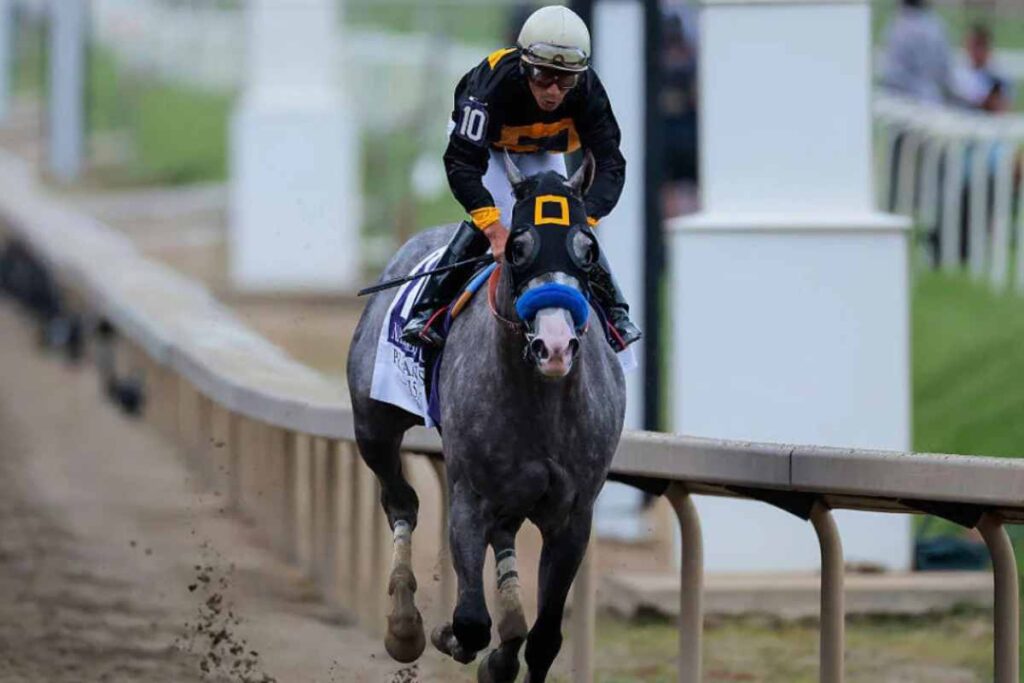
Napoleon Solo Conquers the Preakness Stakes: A Historic Renewal at Laurel Park — The horse racing world witnessed a captivating chapter of resilience and redemption on Saturday evening. Under the gray skies of Maryland, Napoleon Solo thundered back into prominence, rekindling his reputation as one of racing’s most intriguing young colts after capturing the Preakness Stakes in commanding fashion.
The victory was more than just a classic triumph; it was a powerful statement from a horse that many critics had written off. By securing the second jewel of the Triple Crown, Napoleon Solo has completely reshaped the narrative of his sophomore campaign and set the stage for an explosive summer circuit.
A New Backdrop for a Storied Tradition
This year’s edition of the historic race broke decades of tradition. Due to ongoing, massive reconstruction work at Pimlico Race Course, organizers were forced to relocate the event to Laurel Park. This temporary move added an unfamiliar, intimate backdrop to one of American racing’s most historic events.
Unlike the raucous celebrations, massive infield concerts, and overflowing crowds traditionally associated with the Pimlico infield, the atmosphere at Laurel Park was distinctly restrained. Attendance was strictly capped at just 4,800 spectators, creating an exclusive, tense environment where every thud of a hoof could be clearly heard from the grandstands.
Beyond the track conditions, an uneasy cloud hovered over the venue’s future. Industry insiders continue to speculate that Laurel Park could eventually transition into a training-centered complex rather than remain a premier racing destination.
Winning trainer Chad Summers did not hide his frustration regarding the shifting landscape of regional tracks:
“It’s heartbreaking. Tracks like Laurel and Aqueduct are pillars of the sport. Losing places with that kind of heritage damages the foundation of horse racing itself. If this pattern continues, only a handful of major tracks will survive.”
How the Race Was Won: Tactical Brilliance in a Packed Field
With Kentucky Derby conqueror Golden Tempo sidelined and skipping the trip to Maryland, the race unfolded as a remarkably open, chaotic contest. A massive field of 14 runners entered the starting gate—matching the largest field size seen in more than a decade, equaling the 14-horse lineup last witnessed in 2011.
| Finish Position | Horse | Post-Time Odds | Trainer |
| 1st | Napoleon Solo | 7-1 ($17.80 payout) | Chad Summers |
| 2nd | Iron Honor | 9-2 (Co-favorite) | Chad Brown |
| 3rd | Chip Honcho | 11-1 | Approved Independent |
| 4th | Ocelli | – | – |
| 5th | Incredibolt | – | – |
The public ultimately installed local favorite Taj Mahal as the narrow 9-2 choice. Astonishingly, this represented the longest price for a betting favorite since the race adopted its current 1 3/16-mile distance back in 1925, highlighting just how wide-open the handicappers viewed this field.
The Early Pace and the Winning Move
At the break, Taj Mahal exploded forward with immense purpose under jockey instruction, carving out a blistering opening quarter-mile in a sharp 22.66 seconds. While the early aggression delighted local fans, it ultimately drained his late-game momentum.
As the field approached the final turn, Brittany Russell’s unbeaten colt began to labor. That was precisely the moment veteran jockey Paco Lopez launched his bid on Napoleon Solo, surging ominously alongside the leader. Near the top of the lane, Napoleon Solo swept past with authority.
Iron Honor, trained by Chad Brown, mounted a furious, relentless late charge during the closing strides. However, the deficit proved too wide to close. Napoleon Solo crossed the wire 1¼ lengths ahead, stopping the clock in a final time of 1:58.69.
Chad Brown reflected on the narrow loss afterward, noting, “He lost a little ground around both turns. That extra path probably softened him up when the real battle started late.” Meanwhile, longshot Chip Honcho quietly collected third place after producing a steady closing effort from deep in the pack.
Silencing the Critics and Making History
The victory marked a monumental milestone, representing the first-ever Triple Crown race success for both trainer Chad Summers and jockey Paco Lopez.
Napoleon Solo’s raw talent had never truly been questioned by those close to him. Last autumn, he dazzled observers by winning his opening two starts in emphatic style, highlighted by a crushing 6½-length triumph in the prestigious Champagne Stakes.
However, his sophomore season had failed to sustain that momentum. Back-to-back mediocre fifth-place finishes in both the Fountain of Youth and the Wood Memorial sparked widespread skepticism across the racing industry.
Napoleon Solo's Form Cycle:
[Champagne Stakes: 1st] ➔ [Fountain of Youth: 5th] ➔ [Wood Memorial: 5th] ➔ [Preakness Stakes: 1st]
“All season people kept saying, ‘fifth again, fifth again,'” Summers reflected in the winner’s circle. “They believed he wasn’t the same horse anymore. Maybe this wasn’t against the absolute elite—people will say that too. Fine. We’ll discover the truth over the rest of the year.”
Looking Ahead: The Looming Clash with Golden Tempo
While the victory naturally brought joy to Napoleon Solo’s connections, it also stirred fresh ambition for a future showdown against Kentucky Derby champion Golden Tempo. The Derby winner’s absence from Laurel Park admittedly left the event lacking the electric aura typically attached to a Triple Crown sweep attempt, but it sets up a highly anticipated summer rivalry.
“We absolutely hoped he’d show up,” Summers remarked. “When there was still discussion about him running, we were cheering for it. Sadly, it never materialized. Maybe somewhere further down the calendar we’ll finally get that clash.”
For now, plans are pointing directly toward July’s Haskell Stakes at Monmouth Park, a track where jockey Paco Lopez traditionally dominates. A date with destiny against the nation’s top three-year-olds awaits.
Frequently Asked Questions (FAQs)
Where was the Preakness Stakes held this year?
Due to extensive ongoing reconstruction and facility upgrades at Pimlico Race Course, the race was temporarily relocated to Laurel Park in Laurel, Maryland.
Who won the Preakness Stakes?
Napoleon Solo won the race, trained by Chad Summers and ridden to victory by veteran jockey Paco Lopez. He paid out $17.80 on a standard $2 win wager.
Why didn’t the Kentucky Derby winner run?
Golden Tempo’s connections opted to bypass the second leg of the Triple Crown to point for other summer targets, preventing a potential Triple Crown sweep this season.
What was the final winning time of the race?
Napoleon Solo stopped the clock in 1:58.69 for the 1 1/16-mile distance.
Conclusion
Napoleon Solo’s magnificent bounce-back performance proves that championship heart cannot be measured solely by a running line. By conquering a historic 14-horse field under unique circumstances at Laurel Park, the talented colt has earned his place among racing royalty. As the division shifts toward the lucrative summer fixtures, the sport eagerly awaits the eventual heavyweight clash between Napoleon Solo and Golden Tempo.
What do you think of Napoleon Solo’s performance? Can he beat Golden Tempo later this summer? Drop your comments below and share this article with fellow racing fans!